
On this page
Set up one source folder
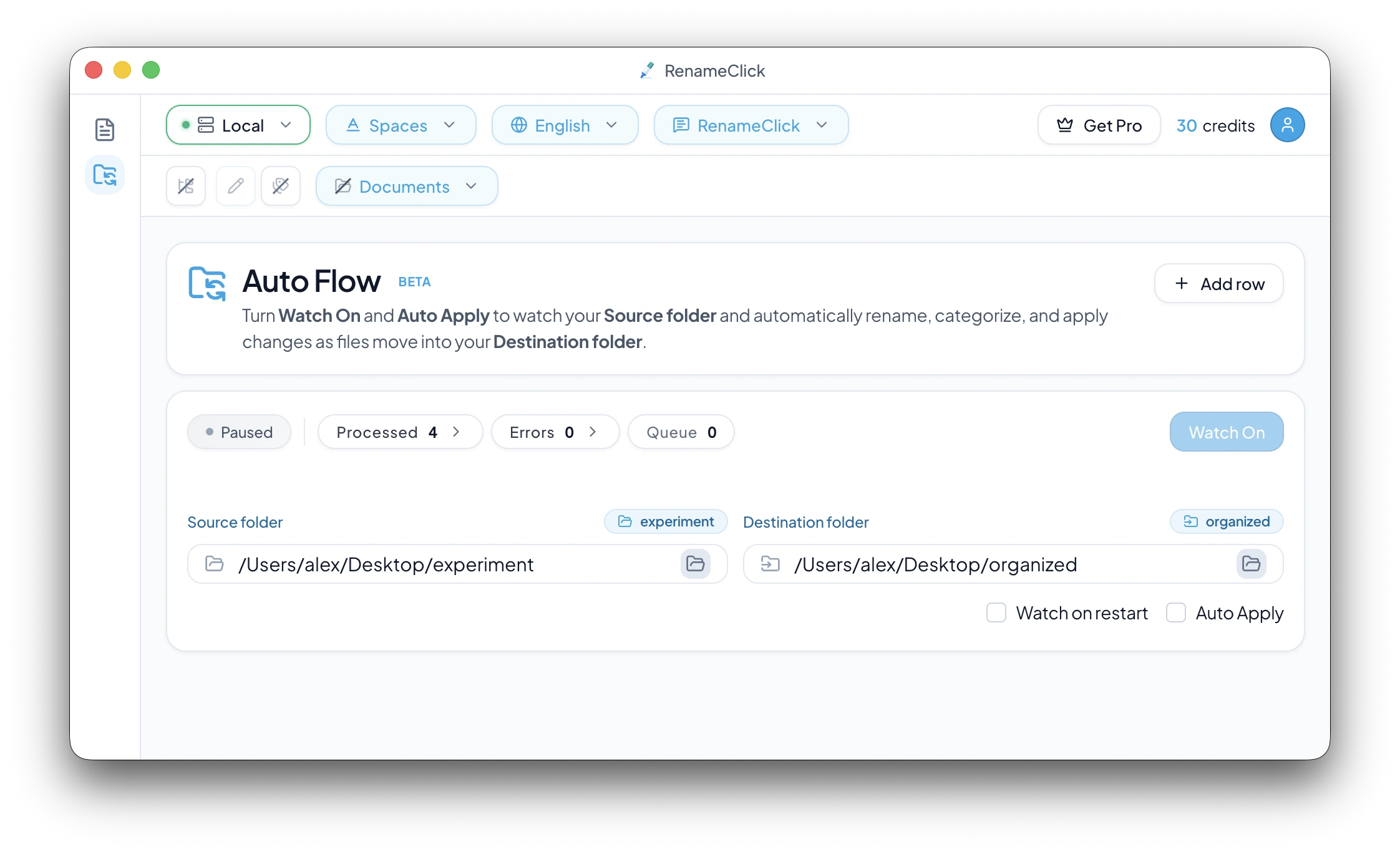
Auto Flow watches a folder and processes new supported files as they arrive. It can rename files, move them into folders, or do both while RenameClick is running.
- Open Auto Flow and add a row.
- Choose the Source folder. Enable Recursive if its subfolders should be watched too.
- Choose a Destination for categorized files.
- Select the file types this rule should process.
- Open the row settings and enable Rename, Categorize, or both.
Use a folder whose contents you understand for the first rule. Unsupported files are skipped. A Downloads rule will not process every archive, installer, or Office file simply because it is in that folder.
Choose how names and folders are decided
For naming, select built-in instructions with a Format and Output Language, or choose a custom prompt that defines its own structure and language. The ordinary formatting controls are disabled for a custom prompt.
For folders, choose AI Categories, Metadata Folders, or Match Folders. The naming prompt and the sorting preset have separate jobs.
Match Folders reads up to 50 existing top-level destination folders. When source and destination are the same, it watches only the files directly inside that folder; unmatched files stay in place and are reported as errors.
See the sorting methods for the full reference.
Separate watching from applying changes
Turn Watch on to scan the source and queue eligible existing files, then listen for incoming changes. Leave Auto Apply off to inspect processed suggestions before applying them.
Turn Auto Apply on when you want the row to rename or move processed files without another click. This is a setting for that row, not a requirement for using Watch.
Auto Flow waits for file size to remain stable before processing and ignores empty files. A paused or interrupted download can also appear stable; the check is not a guarantee that the download is complete.
Read Processed, Applied, and Errors
| View | What to check |
|---|---|
| Processed | Proposed names and destinations waiting to be applied. |
| Applied | Changes already written to disk. |
| Errors | Files that could not be processed or applied, including unmatched in-place Match Folders files. |
Check permission errors, unsupported or unreadable content, and unavailable providers separately from a poor naming suggestion. Retry after correcting the cause.
Turn Watch off before Undo or Redo. Undo depends on the current workspace’s in-memory history and the files still being available. A saved Applied list is not permanent undo history.
Add rules for other folders or stages
Each row keeps its own source, destination, filters, and naming or categorization settings. This lets a scans folder use different instructions from a screenshots folder.
Version 2.15.2 also supports routing an applied file into another row’s source. The destination-to-source connection defines the stages; the order of rows on screen does not.
Cycles and the same source with overlapping file-type filters are rejected. Narrow filters or change the folders when a row reports a conflict.
See connecting Auto Flow rules for the full reference.
Keep RenameClick running
Watch works while the app is running. Auto Flow saves its rows and can restore watching after restart according to the saved state. Recheck that the source is available, the provider is ready, and Watch is on.
If a downstream rule was off when a file arrived, start that rule to scan its source. The earlier stage does not imply that the later stage has finished.
See Auto Flow controls and folder restrictions for the full reference.
See a Downloads setup for the full reference.