Downloads automation
Organize Your Downloads Folder with Auto Flow
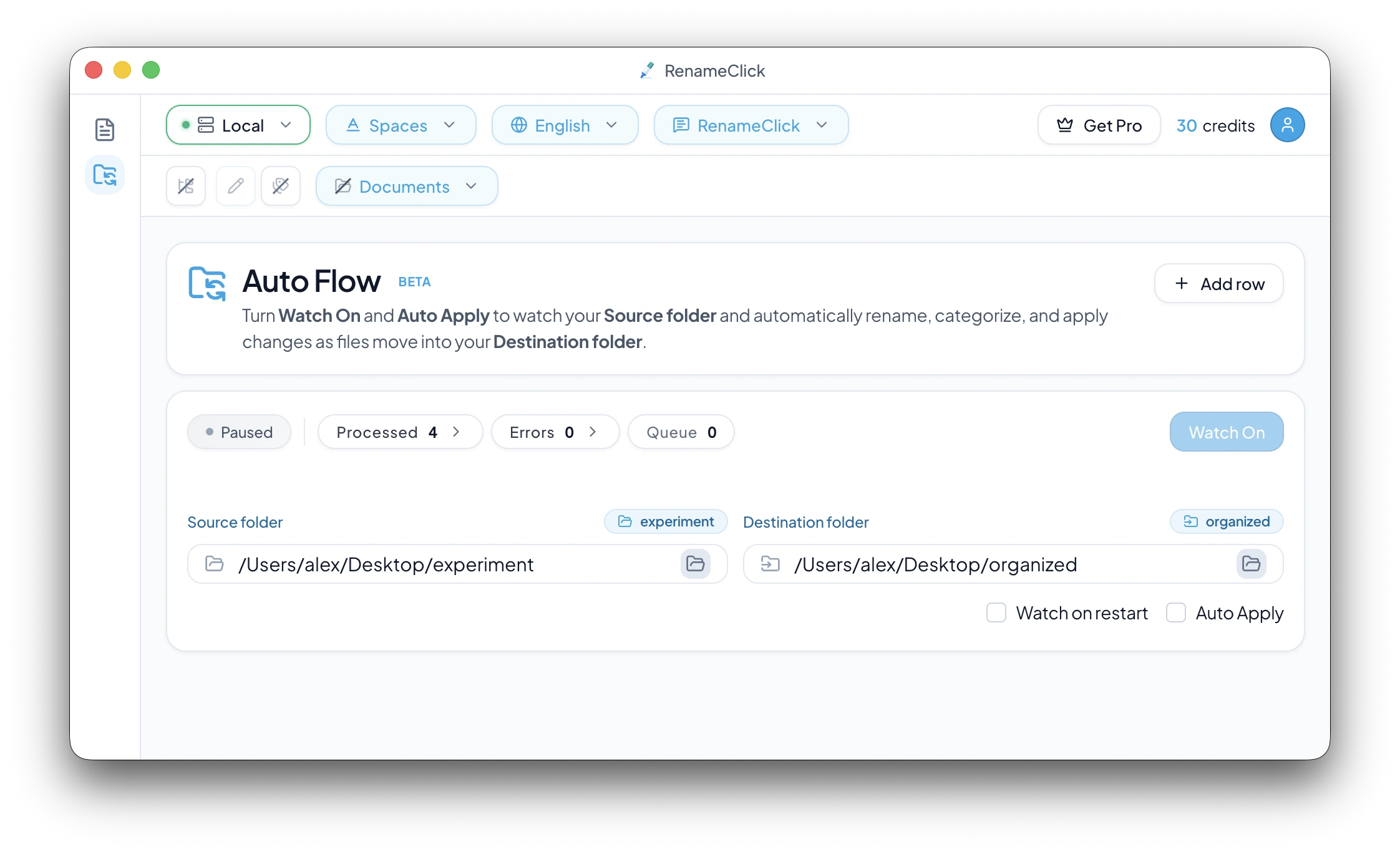
Process supported downloads with a watched-folder rule. Rename files, sort them into folders, and choose whether each change needs approval.

Start with the files already there
When Watch starts, Auto Flow scans eligible files already in the source, then watches for incoming changes while RenameClick runs. Choose Recursive only if the rule should also include subfolders.
Existing and incoming files
File-type filters per rule
Optional Auto Apply
Choose which downloads belong in the rule
- PDFs and scans that should move into document categories.
- Photos and screenshots that need names or date folders.
- Supported text documents and recordings, with the required capabilities installed.
Get started
- 1
Choose Downloads as an Auto Flow source and select the file types.
- 2
Set a destination and naming or sorting preset. Start Watch with Auto Apply off.
- 3
Inspect the first proposed changes, apply them, and decide whether to enable Auto Apply.
Set a destination that fits the rule
Use AI Categories for document types, Metadata Folders for date or EXIF paths, or Match Folders for existing client folders. Match Folders considers up to 50 top-level folders. With a separate output, unmatched files are applied to its root.
Allow time for a download to finish
Auto Flow waits for size and modification time to remain stable for the rule’s delay and ignores 0-byte files. A transfer can pause before it finishes, so stability is not proof of completion. Increase the delay when your downloads arrive in stages and inspect errors separately.
Leave unsupported downloads alone
The file-type filter only admits supported formats. Archives, installers, videos, and unsupported Office formats are not unpacked or converted by RenameClick.
Review results and keep watching
Processed contains suggestions waiting for apply; Applied records completed changes; Errors shows failures. Watch must be off for Undo or Redo, and undo history is not retained indefinitely across restarts.
For a second processing stage, connect the destination to another row’s source. Applied files can continue there; screen order does not define the sequence.
Run locally or choose another provider
Choose Local for on-device analysis after downloading its model. Optional cloud providers in the direct macOS and Windows builds use your API key and receive content for analysis; their charges are separate. The Mac App Store build excludes cloud providers.
Analysis does not use RenameClick credits. Free includes 30 renames or moves each month. Renaming and moving one file in the same action uses one credit; failed changes use none. Pro removes the apply limit. External API charges are separate.
See the workflow in RenameClick

Documentation and guide
Check the documented controls and edge cases, or follow the practical setup guide.
More solutions
Explore related workflows
AI File Renamer for Mac and Windows
Rename documents, images, and spoken recordings from their contents. Check suggested names, edit what needs changing, and apply the selected files.
Rename Audio Files by What They Say
Give voice notes, interviews, lectures, and other spoken recordings names based on their topic. Transcription runs locally; choose Local AI to keep naming local too.
Find Files by Their Contents
Choose a folder and describe the document or image you need. RenameClick checks supported files against your query, even when you do not know their filenames.
Ready to try it on your own files?
On macOS and Windows, the Local provider works offline after its one-time model download. Review suggestions before applying changes.